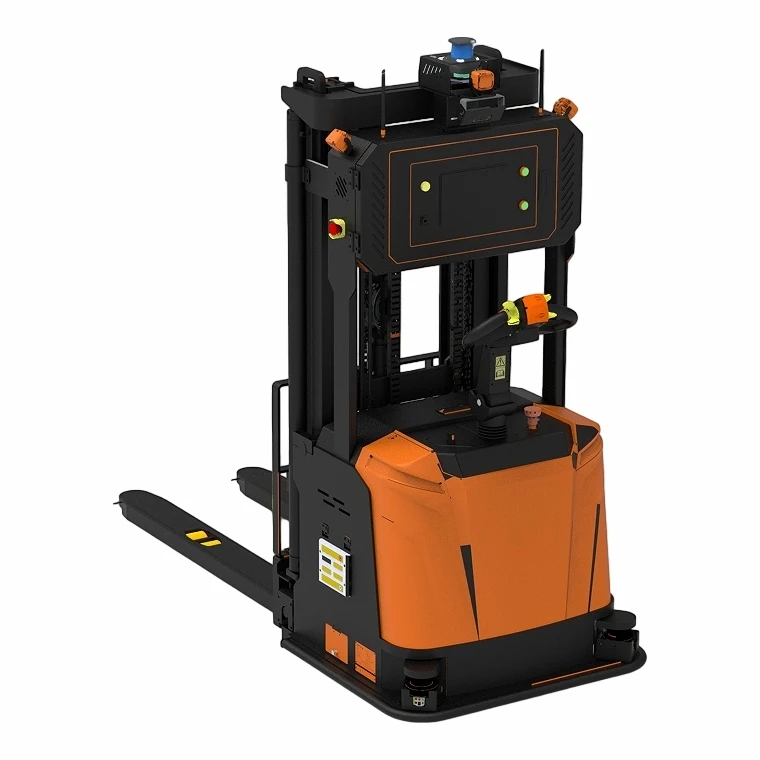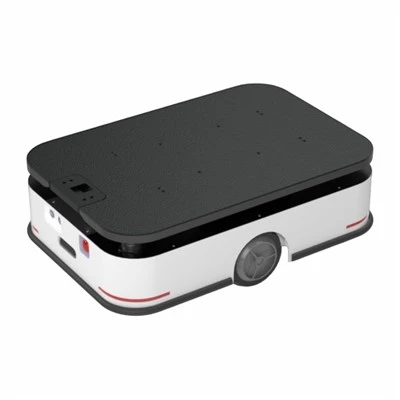

The primary configuration of an automated pallet forklift typically comprises a mechanical structure system, a drive system, a lifting system, a perception system, and a control system; these components work in concert to enable the autonomous transport and stacking of goods.
The mechanical structure system forms the foundation of the vehicle, consisting mainly of the chassis, forks, mast, and protective structures. The chassis is generally constructed from high-strength steel to ensure overall load-bearing capacity and operational stability, while the forks and mast are designed to directly support and lift palletized loads, balancing structural strength and precision to meet operational requirements across varying heights and weights.
The drive and lifting systems are critical components for enabling movement and material handling. The drive system typically consists of a drive motor, a reduction gear, and drive wheels, controlling the forklift's forward and backward movement as well as steering. The lifting system generally employs electric or hydraulic actuation to raise and lower the forks for picking, placing, and stacking palletized goods, thereby adapting to operations at various storage heights.
The perception and control systems are central to the automated pallet forklift's intelligent operation. The perception system usually incorporates LiDAR, cameras, and ultrasonic sensors for environmental recognition and obstacle detection, while the control system handles data processing, path planning, and motion control to facilitate autonomous navigation and task execution. Furthermore, the system can interface with warehouse management systems to enable task scheduling and information sharing, thereby enhancing overall operational efficiency.