


Hey there! As a supplier of automated guided vehicles (AGVs), I often get asked about how these nifty machines select the optimal path. It's a fascinating topic, and I'm excited to share some insights with you.
First off, let's talk about what an AGV is. In simple terms, an AGV is a self - guided vehicle that can move around a warehouse, factory, or other industrial settings without the need for a human operator. They're super useful for tasks like transporting goods, materials, and even equipment from one place to another.
Our AMR & AGV solutions adopt advanced SLAM navigation and intelligent traffic scheduling system to realize real-time optimal path planning in constantly changing warehouse environments.
Now, onto the main question: how do AGVs select the optimal path? There are several factors and methods involved in this process.
1. Map - based Navigation
One of the most common ways AGVs find their way is through map - based navigation. Before an AGV starts operating, it's provided with a digital map of the area it will be moving in. This map can be created using various methods, such as laser scanners or 3D mapping technologies.
The AGV uses this map to understand the layout of the environment, including the location of obstacles, storage areas, and other important features. When it needs to move from point A to point B, it analyzes the map to find the shortest and most efficient route. For example, if there's a big storage rack blocking a direct path, the AGV will look for an alternative route that avoids the obstacle.
2. Sensor Technology
AGVs are equipped with a variety of sensors that help them detect their surroundings in real - time. These sensors include laser scanners, cameras, ultrasonic sensors, and proximity sensors.

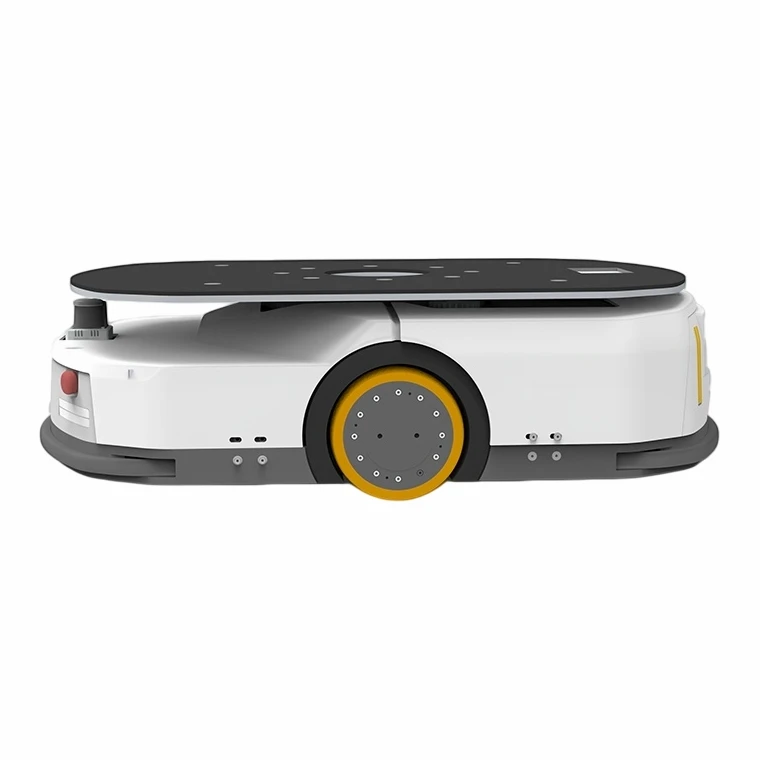
Laser scanners are particularly useful as they can create a 3D model of the environment around the AGV. This allows the AGV to detect obstacles, other vehicles, and even changes in the terrain. If the AGV senses an obstacle in its planned path, it can quickly adjust its route to avoid a collision.
Cameras are also important. They can be used to recognize visual markers on the floor or walls, which can help the AGV determine its position more accurately. Ultrasonic sensors are great for detecting objects at close range, and proximity sensors can sense when the AGV is getting too close to another object.
3. Traffic Management Systems
In a busy industrial environment, there may be multiple AGVs operating at the same time. To ensure that they all move efficiently and safely, traffic management systems are used.
These systems keep track of the position and movement of all the AGVs in the area. They can assign priorities to different AGVs, so that if two AGVs are approaching an intersection, the system can decide which one should go first. This helps to prevent traffic jams and collisions.
4. Dynamic Path Planning
Sometimes, the environment can change unexpectedly. For example, a new obstacle may be placed in the AGV's path, or a storage area may be reorganized. In such cases, AGVs need to be able to adapt and find a new optimal path.
Dynamic path planning algorithms allow AGVs to continuously evaluate their route and make adjustments as needed. These algorithms take into account the current position of the AGV, the location of obstacles, and the destination. They can quickly calculate a new route that takes the changes into account.
Our AGV Products
At our company, we offer a range of high - quality AGVs that are designed to select the optimal path efficiently. Here are some of our popular products:
- Jacking Robot 400KG: This jacking robot can lift up to 400KG and is great for applications where heavy loads need to be moved vertically.
- Latent Robort 600KG: The latent robot is designed to operate in tight spaces and can handle a load of up to 600KG.
- Automated Guided Vehicle 600KG: This AGV is a versatile option that can be used for a wide range of material handling tasks, with a maximum load capacity of 600KG.
- Jacking Robot 600KG: Similar to the 400KG jacking robot, but with a higher load capacity, it's perfect for heavy - duty applications.
- Rotary Robot 600KG: The rotary robot can rotate the load, which is useful for applications where the orientation of the load needs to be changed.
Contact Us for Purchase
If you're interested in improving your material handling processes with our AGVs, we'd love to hear from you. Whether you're a small - scale business or a large industrial operation, our AGVs can help you increase efficiency, reduce costs, and improve safety.
We have a team of experts who can work with you to understand your specific needs and recommend the best AGV solution for your business. So, don't hesitate to reach out and start a conversation about how our AGVs can benefit your operations.
References
- LaValle, S. M. (2006). Planning algorithms. Cambridge university press.
- Thrun, S., Burgard, W., & Fox, D. (2005). Probabilistic robotics. MIT press.