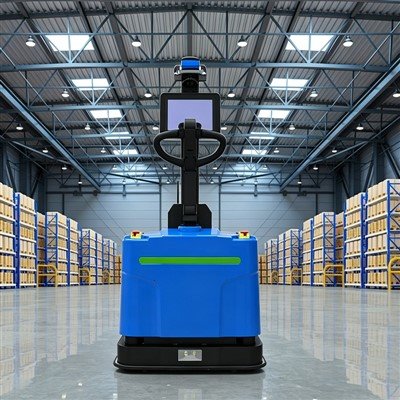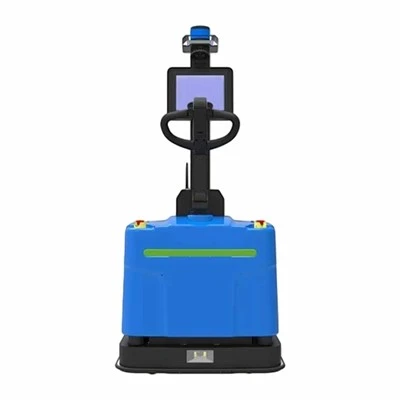


If you’ve ever walked through a bustling, 24/7 distribution center or a tightly packed warehouse where pallets of goods move seamlessly from loading docks to storage racks without a single operator behind the wheel, you’ve likely encountered an automatic pallet forklift—one of the unsung workhorses of modern logistics. As a supplier that’s spent years refining these machines to solve real-world pain points (like labor shortages, erratic operation times, and tight storage space), I’m often asked a question that sounds simple but runs deep: What programming languages and software actually power these automated forklifts? The answer isn’t just a list of code tools; it’s a carefully chosen ecosystem of hardware-specific languages, industry-standard platforms, and custom-built software that turns a steel, hydraulics, and battery-powered machine into a precise, reliable part of a warehouse’s backbone. Let me break down what we use, why we use it, and how it all works together to keep our Smart Automated Forklift and other models running smoothly.


First, it’s important to ground this in the unique demands of an automatic pallet forklift. Unlike a consumer smartphone or a website, these machines operate in dynamic, often unstructured environments: they have to avoid pallets that are slightly misaligned, navigate around human workers who might walk into their path, adjust for sloped warehouse floors, and handle fragile or heavy loads without damage. That means their programming has to balance two competing needs: extreme precision (to lift a 2,000-pound pallet 20 feet high in a narrow aisle) and flexibility (to adapt when a storage bin is moved or a new pallet is added). For our team, that starts with two foundational layers: low-level programming for the forklift’s core hardware, and mid-to-high-level software for its navigation and decision-making.
Let’s start with the low-level programming—this is the code that talks directly to the forklift’s physical parts, and it’s where we’ve leaned most heavily on C and C++. You might hear people say C is “old” compared to newer languages like Python, but for real-time control systems (systems that have to respond to input in milliseconds or less), it’s still the gold standard. Our forklift’s hydraulic valves, motor drives, and safety sensors need immediate, predictable instructions: “lift the forks exactly 12 inches to clear a pallet” or “stop within 6 inches when an obstacle is detected.” C gives us direct access to the machine’s hardware registers without the overhead of higher-level languages, which is non-negotiable for avoiding lag. C++ is also a staple here, especially for tasks that need a bit more flexibility while still being fast, like managing the forklift’s battery power or coordinating movement between its wheels and forks. We use these languages to build what’s called the “machine control module” (MCM)—the brain that translates high-level commands from the navigation system into physical action.
That said, pure C and C++ would be impossible to manage for all the complex logic an automatic forklift needs, which is why we layer in higher-level languages for everything that isn’t tied directly to hardware. Python is our go-to here for navigation logic, safety monitoring, and user-facing tools. Wait—Python is often seen as a scripting language for small tasks, but in recent years, it’s become way more capable for industrial use, thanks to libraries that handle sensor data, mapping, and communication. For example, our forklifts use LiDAR (light detection and ranging), cameras, and ultrasonic sensors to build a real-time map of the warehouse environment. Python lets us process that sensor data quickly, filter out noise (like a stray piece of tape or a hanging pallet), and update the forklift’s path every 100 milliseconds. We also use Python for our fleet management software, which lets warehouse managers track all our Warehouse Automated Stacker and forklifts, set delivery schedules, and adjust routes from a central dashboard. The key here is that Python gives us the flexibility to iterate fast—if a warehouse needs a new rule, like “stop when a worker’s ID badge is within 3 feet,” we can add that logic in Python in a matter of hours, instead of weeks, which is critical for our customers who often have unique warehouse layouts.
Another critical piece of the software puzzle is the navigation stack, and this is where Robot Operating System (ROS) comes into play. ROS is an open-source framework built specifically for robotics, and it’s become the de facto standard for mobile robots—including automatic pallet forklifts. Before we adopted ROS a few years back, we were building our own navigation code from scratch, which was error-prone and hard to update. Now, ROS gives us pre-built packages for things like simultaneous localization and mapping (SLAM), which lets a forklift create a map of the warehouse the first time it drives through, then locate itself on that map with centimeter-level accuracy. We use ROS with our own custom C and C++ modules for hardware control, so the navigation stack (written in a mix of C++ and Python) can send commands to the MCM to move the forklift from Point A to Point B. For our Narrow Aisle Stacking Forklift, which operates in aisles that are just 10 inches wider than the forklift itself, this level of precision is non-negotiable—one wrong move could cause a collision with a rack or a pallet.
We also rely heavily on software tools that aren’t programming languages per se, but are essential for building, testing, and deploying our forklifts. One of the most important is our simulation software, which we built using Unity, a game engine that’s traditionally used for video games. You might be confused—why use a game engine for industrial equipment? Because Unity lets us create a 3D, physics-accurate simulation of any customer’s warehouse, complete with exact rack layouts, pallet weights, floor slopes, and even human worker movement patterns. Before we ship a forklift to a new customer, we simulate hundreds of runs to test for edge cases: what if a pallet is slightly damaged? What if a worker walks into the forklift’s path at a busy time? This lets us fix bugs before the forklift ever touches the customer’s floor, which saves our customers time and reduces downtime. We also use Git for version control (the same tool used by software developers worldwide) to track every change we make to our code—whether it’s a tiny fix to the hydraulic control code or a major update to the navigation stack—so we can roll back to a stable version if something goes wrong.
A common question we get is: do we ever use proprietary software instead of open-source tools? The short answer is yes, in specific, critical areas. For example, our safety systems are built on a proprietary platform from a leading industrial automation vendor, because safety in logistics isn’t something to leave to open-source tools. Automatic pallet forklifts have to meet strict international safety standards (like ISO 3691-4 for industrial trucks), and proprietary safety software is designed to meet those standards with third-party certification, which is non-negotiable for our customers. This software acts as a fail-safe: if the navigation system sends a command that would cause a collision, the safety system overrides it immediately, regardless of what the main code is doing. We also use proprietary fleet management software for large customers with dozens of forklifts, because it integrates with their existing warehouse management systems (WMS) like SAP or Oracle, which is something open-source tools can’t always do seamlessly.
It’s worth noting that the technology isn’t one-size-fits-all across our line of automatic forklifts. For example, our Automatic Dual-Mode Pallet Forklift can switch between fully autonomous mode and manual mode for occasional, on-the-fly tasks, like moving a pallet that’s outside the predefined map. For the manual mode, we use a slightly different set of code: Python for the driver interface, so operators can easily adjust the forklift’s path or speed using a tablet, and the same C-based hardware control code, so the forklift’s physical movements are consistent whether it’s operating autonomously or manually. Our Warehouse Automatic Stacker Forklift, which is designed for high-volume e-commerce warehouses, has an extra layer of code for order prioritization—Python scripts that adjust which pallets to pick first based on order deadlines, which is a huge benefit for customers dealing with seasonal spikes in online orders.
Another thing that separates industrial forklift programming from other robotics is the need for reliability. A consumer robot vacuum might get stuck every few days, but an automatic pallet forklift has to operate 16-20 hours a day, 5 days a week. That means our code has to be tested for durability: we run our forklifts 24/7 in our test facility for weeks at a time, simulating every possible scenario, from cold storage warehouses (where temperatures are 0°F) to humid distribution centers in the Southeast U.S. We also use tools like Jenkins for continuous integration, which automatically builds and tests our code every time a developer makes a change, so we catch bugs early before they reach the customer.
Over the years, we’ve made a point of balancing new technologies with proven ones. When ROS 2 came out a few years ago, we didn’t jump in immediately—we waited until it was stable enough for industrial use, and now it’s the core of our navigation system. We’ve also started integrating small parts of machine learning, like using TensorFlow Lite (a lightweight version of TensorFlow for edge devices) to help our forklifts recognize different pallet types and adjust their lifting pressure accordingly, which reduces damage to fragile pallets. But we never forget that at the end of the day, a forklift is a piece of industrial equipment, not a data center—so we never add complexity that would compromise reliability for a small gain in flexibility.
If you’re a warehouse manager or operations lead considering adding automatic pallet forklifts to your facility, the programming and software ecosystem is a big reason to work with a supplier that has deep expertise in this space. It’s not just about having a “smart” forklift—it’s about having a forklift whose code is tailored to your specific warehouse, meets safety standards, and can integrate with your existing systems. Our team works closely with customers to map their unique layouts, test for their specific use cases, and ensure that our software aligns with their operational goals. Whether you need a forklift for narrow aisles, high-volume stacking, or dual-mode operation, we have the technology to make it work seamlessly.
If you’re ready to explore how our automatic pallet forklifts can transform your warehouse operations, we’re here to help. We can walk you through the technical details, discuss your specific needs, and show you how our programming and software ecosystem delivers the reliability and efficiency you need. To connect with our sales team and start a conversation, please reach out to us directly.
References
- International Organization for Standardization. (2020). ISO 3691-4:2020: Industrial trucks – Safety and verification – Part 4: Driverless industrial trucks and their systems. Geneva, Switzerland: ISO.
- Smart Robotics. (2022). The Role of ROS in Industrial Autonomous Mobile Robots. Retrieved from https://www.smartrobotics.com/whitepapers/ros-industrial-robots
- Wäppling, C. (2021). Real-Time Programming for Industrial Control Systems. Industrial Automation Magazine, 18(3), 45-52.
- Unity Technologies. (2023). Simulating Industrial Robotics for Warehouse Applications. Retrieved from https://unity.com/solutions/industrial-robotics
- PyTorch. (2022). TensorFlow Lite for Edge Robotics. Retrieved from https://www.tensorflow.org/lite/examples/robotics_overview