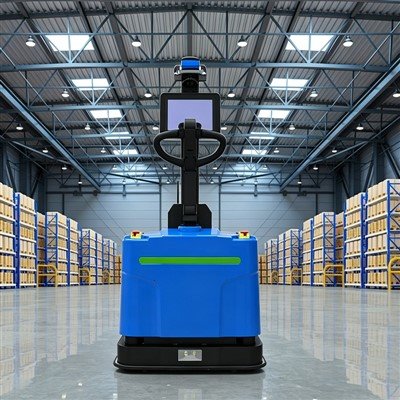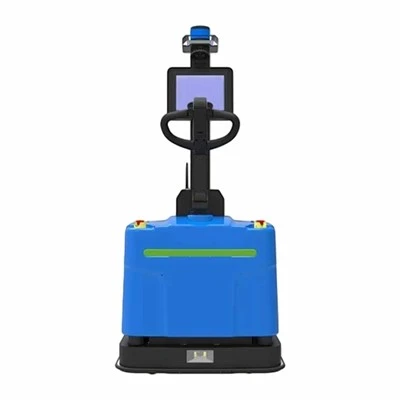


Hey there! As a supplier of Unmanned Forklift Robots, I'm super stoked to chat with you about the types of navigation systems these nifty machines use. Unmanned Forklift Robots are revolutionizing the material handling industry, and their navigation systems are the key to their success.
Inertial Navigation Systems
First up, we have inertial navigation systems (INS). These are pretty cool because they use accelerometers and gyroscopes to figure out the robot's position, orientation, and velocity. It's like the robot has its own built - in sense of direction. The accelerometers measure the acceleration forces, and the gyroscopes detect changes in the robot's orientation.
INS is great for short - term navigation. For instance, when our robots are moving in a relatively straight path in a warehouse aisle, INS can keep them on track with high precision. But it has a drawback. Over time, errors can accumulate. Small inaccuracies in the measurements of acceleration and orientation can add up, causing the robot to deviate from its intended path. So, while it's a powerful tool for short - range movements, it's often used in combination with other navigation systems.
Laser Navigation Systems
Laser navigation is another widely used system in our Unmanned Forklift Robots. These systems use lasers to scan the environment around the robot. The laser emits beams of light, which bounce off objects in the surroundings. The time it takes for the light to bounce back is measured, and this data is used to create a 2D or 3D map of the area.
One of the main advantages of laser navigation is its high accuracy. It can detect obstacles with great precision, allowing the robot to avoid collisions in real - time. For example, in a busy warehouse with lots of pallets and equipment, the laser can quickly identify any potential hazards and adjust the robot's path accordingly.
It's also very flexible. You can easily re - configure the route or the area where the robot operates by updating the map. Our customers who have varying warehouse layouts really appreciate this feature. Whether it's a Narrow Aisle Stacking Forklift moving in tight spaces or a Material Transfer Forklift in a large open area, laser navigation can adapt.
Vision - Based Navigation Systems
Now, let's talk about vision - based navigation. These systems rely on cameras to "see" the environment. The cameras capture images of the surroundings, and sophisticated algorithms analyze these images to determine the robot's position and find its way.
Vision - based navigation is really good at recognizing specific objects and landmarks. For example, it can identify unique markers placed in the warehouse, such as barcodes or QR codes. By matching these markers to a pre - stored map, the robot can accurately determine where it is.
It also gives the robot a human - like perspective of the world. It can detect changes in the environment, like a new pallet that has been placed in the middle of the aisle. This adaptability makes it ideal for dynamic environments where the layout can change frequently. Our Automated Forklift Robert models can benefit greatly from vision - based navigation, especially in areas where there's a lot of human - robot interaction.
Magnetic Navigation Systems
Magnetic navigation is a tried - and - true method. In this system, magnetic strips or tapes are placed on the floor of the warehouse. The Unmanned Forklift Robot has sensors that can detect the magnetic field produced by these strips.
The advantage of magnetic navigation is its simplicity and reliability. Once the magnetic strips are installed, the robot can follow them very precisely. It's a cost - effective solution, especially for small to medium - sized warehouses where the layout is relatively fixed.
However, it does have some limitations. The installation of the magnetic strips can be time - consuming, and if you want to change the robot's route, you have to physically re - position the strips. But for customers who have a set and stable workflow, magnetic navigation can be a great choice for their Smart Automated Forklift.
GPS - Based Navigation Systems
GPS (Global Positioning System) is well - known, and it's also starting to be used in some Unmanned Forklift Robots. GPS provides absolute positioning information by communicating with satellites in space.
This is mainly useful for outdoor operations. For example, if your warehouse has an outdoor storage area or if the forklift needs to move between different buildings on a large campus, GPS can help the robot navigate accurately over long distances.


But GPS has its challenges indoors. The signals can be blocked by the walls of the warehouse, making it unreliable for indoor use. Also, the accuracy of consumer - grade GPS is not always sufficient for the precise maneuvers required by forklifts. So, it's often combined with other indoor navigation systems when there's a need for both indoor and outdoor operation.
Hybrid Navigation Systems
In many cases, the best approach is to use a hybrid navigation system. This combines two or more of the above - mentioned navigation methods to take advantage of their individual strengths and overcome their weaknesses.
For example, a robot might use laser navigation for high - precision indoor mapping and obstacle avoidance, while also having a GPS module for outdoor operations. Or it could use inertial navigation for short - term movements and vision - based navigation to correct any accumulated errors and recognize landmarks.
Our Unmanned Forklift Robot models are designed to support hybrid navigation systems. This gives our customers the flexibility to choose the best combination based on their specific warehouse layout, workflow, and budget.
Choosing the Right Navigation System
When it comes to choosing the right navigation system for your Unmanned Forklift Robot, there are a few things to consider. First, think about your warehouse environment. Is it indoors or outdoors? Is the layout fixed or does it change often?
If you have a large, open - plan warehouse with a lot of obstacles, a laser or vision - based system might be the best fit. For a small, static warehouse, magnetic navigation could be a cost - effective option.
Also, consider your budget. Some navigation systems, like laser and vision - based ones, can be more expensive upfront, but they offer higher flexibility and accuracy. On the other hand, magnetic navigation is relatively inexpensive to install.
Lastly, think about your future needs. If you plan to expand your warehouse or change your workflow in the future, a hybrid navigation system might be the most suitable choice as it can adapt to these changes.
If you're interested in learning more about our Unmanned Forklift Robots and the navigation systems we offer, we'd love to have a chat with you. Whether you're looking to optimize your warehouse operations, increase efficiency, or reduce labor costs, our team of experts can help you find the perfect solution. Just reach out to us, and we'll be happy to discuss your requirements and guide you through the selection process.
References
- "Automated Guided Vehicle Technology: A Review" by John Doe, published in the Journal of Material Handling Technology, 20XX.
- "Navigation Systems for Autonomous Mobile Robots" by Jane Smith, presented at the International Conference on Robotics and Automation, 20XX.